


Time Secure Network

TIME SECURE
 NETWORK

Your First Line of Defence Starts with Your Network​

Network-native, intent-based threat intelligence built directly into Time’s fully owned WAN — enabling earlier visibility, earlier action, and lower breach risk.

Detect attacker intent before exploitation

Detect attacker intent before exploitation

ISP-level visibility no standalone tool can provide

ISP-level visibility no standalone tool can provide

Resilient connectivity for hybrid & multicloud

No agents. No network redesign. No operational disruption.

Traditional Detection Tools React Too Late

Most traditional security tools are built to respond only after malicious activity occurs. By the time alerts are raised, attackers may have already scoped your environment, tested access paths, and identified exploitable weaknesses.

Detection Happens After the Fact

Detection Happens After the Fact

Most traditional security tools respond only after an exploitation attempt has occurred, when damage may already be underway.

Attackers Gain the Upper Hand

Attackers Gain the Upper Hand

Before an alert is triggered, attackers often have time to study your environment, probe access paths, and identify vulnerabilities.

Event-Based, Not Intent-Driven

Event-Based, Not Intent-Driven

Firewalls, endpoints, and SIEM/XDR remain essential — but they are designed to detect events, not recognise attacker intent.

The real question isn’t whether you can detect an attack — it’s how early you recognise attacker intent before it becomes one.

Modern Attacks Don’t Start with Exploits

Modern cyberattacks follow a predictable pattern.

Attackers move deliberately — gathering intelligence and testing access long before any exploit occurs, in line with the MITRE ATT&CK® framework.

01

Reconnaissance & Scanning

Attackers scan networks and probe exposed services to understand the environment.

02

Credential Testing & Path Building

Access points are tested and potential paths into the network are quietly mapped.

03

Vulnerability Identification

Weaknesses and misconfigurations are identified for later exploitation.

04

Exploitation & Lateral Movement

Only then do attackers exploit vulnerabilities and move across systems.

Bottom Line

Most damage happens long before alerts are triggered. Security today isn’t just about stopping attacks — it’s about preventing them earlier in the kill chain.

Why Event-Based Detection Still Falls Short

Not because security tools don’t work — but because detection depends on events, not early attacker intent. When detection is event-driven, action only begins after attacker activity has already occurred.

How Traditional Security Tools Detect Threats

Firewalls

Firewalls

Rely on signatures, rules, and known threat intelligence


→ Effective against known threats; limited against emerging or intent-based activity

Endpoints

Endpoints

Detect suspicious behaviour after execution on the device


→ Visibility begins after compromise

SIEM /XDR

SIEM /XDR

Correlate alerts after logs and telemetry are generated


→ Detection is reactive, not proactive

The Gap

The Gap

Detection still begins with an event.

By the time alerts appear, attackers are already inside the environment.

How Most Traditional Security Environments Are Structured Today

In many environments, detection begins at the firewall or endpoint — after malicious activity has already reached the network.
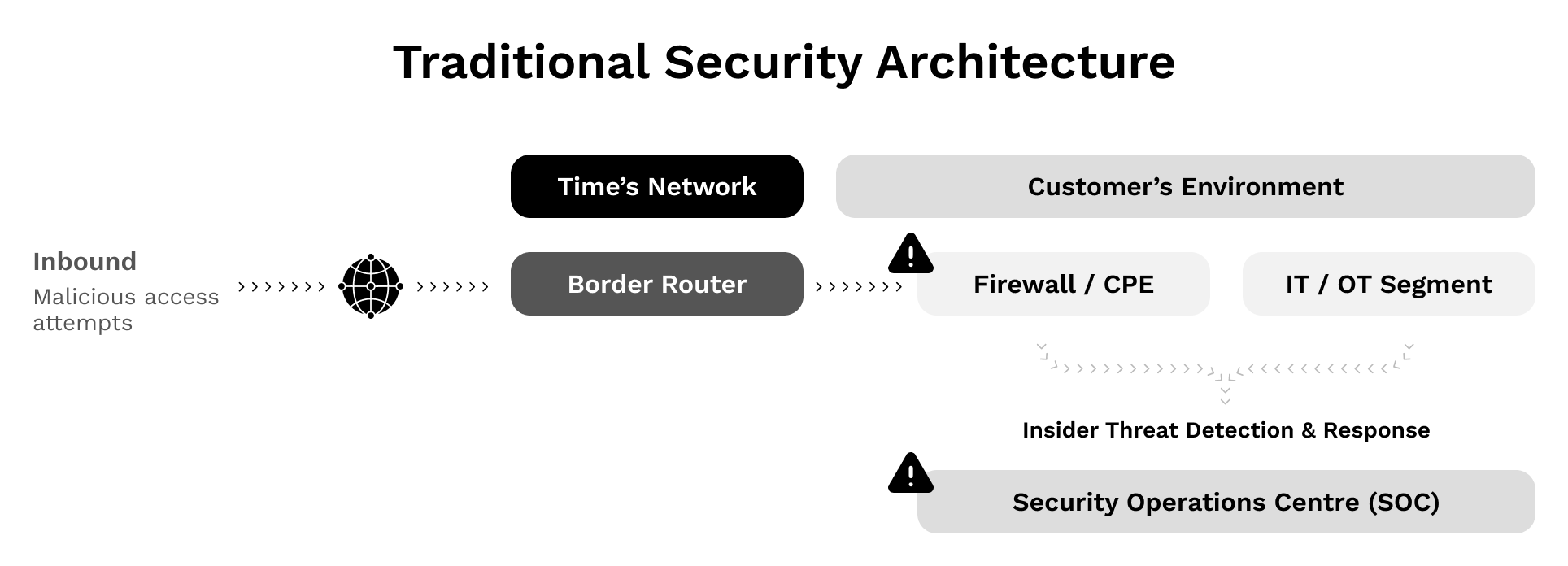

Traditional Security Architecture

Threat detection begins too late


By the time threats are detected at the firewall or endpoint, attackers may already be operating inside the network.

Limited visibility into outbound traffic


Suspicious outbound connections and insider-driven activity often go undetected.

SOC teams overwhelmed by alerts


High alert volumes increase analyst fatigue and the risk of missed signals.

Security Should Start Before Attackers Get Inside

If most attacks begin with reconnaissance, probing, and credential testing, then security shouldn’t wait for exploitation to occur.

Time Secure Network

Time Secure Network
changes where detection begins.

Instead of waiting for alerts after malicious activity executes, Time Secure Network detects attacker intent at the network level, before systems are compromised and before damage begins.

What This Enables

Detect intent, not just incidents

Detect intent, not just incidents

Identify reconnaissance, abnormal access patterns, and malicious behaviour before exploitation attempts succeed.

Act earlier in the kill chain

Act earlier in the kill chain

Stop threats during scanning, probing, and path-building — long before traditional detection is triggered.

Reduce breach impact and response time

Reduce breach impact and response time

Earlier detection means fewer blind spots, faster decisions, and lower operational and financial risk.

Built Into the Network. Designed to See What Others Can’t.

Time Secure Network is a network-native security capability embedded directly into Time’s fully owned WAN infrastructure.

By analysing traffic patterns, behaviours, and intent signals as they traverse Time’s network, it provides visibility that standalone, in-environment tools simply cannot achieve.
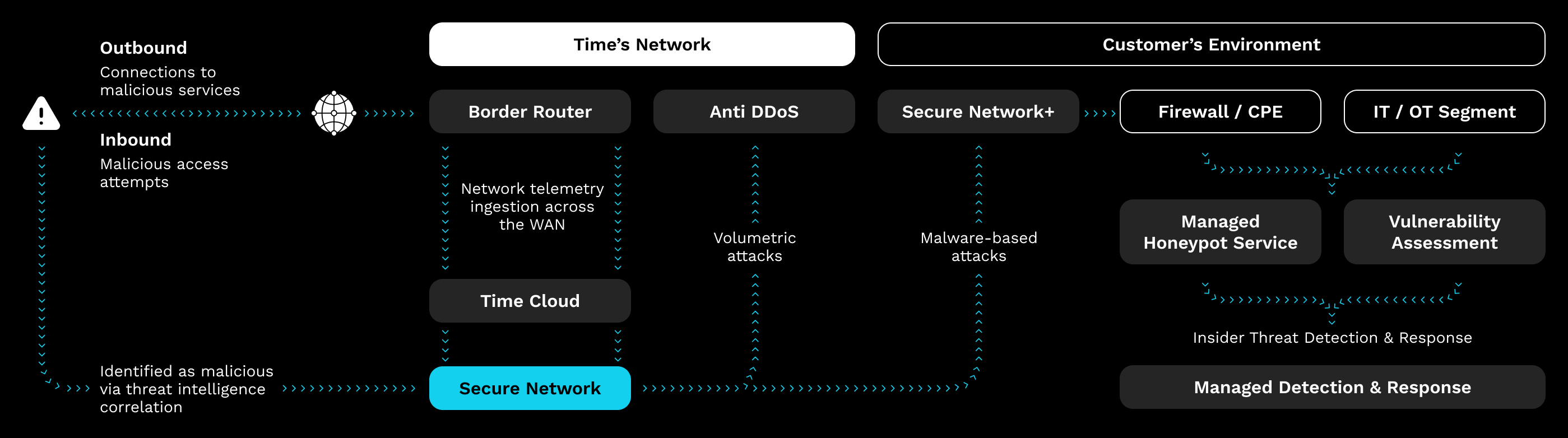
Time Secure Network VIEW FULL DIAGRAM

Designed to complement your existing security stack — detecting threats earlier in the attack lifecycle so teams can act before traditional defences are triggered.

How It Works

01

Observes traffic at the network edge

Threat activity is analysed at Time’s network layer — before traffic reaches customer firewalls, endpoints, or applications.

02

Identifies abnormal and malicious intent

The platform detects behaviours such as:

  • Reconnaissance and scanning
  • Credential testing and abuse
  • Command-and-control communication
  • Early indicators of DDoS preparation

03

Flags risk before exploitation

Instead of waiting for malware execution or log correlation, suspicious intent is flagged while attacks are still forming.

04

Enables earlier action and response

Security teams can block, contain, or remediate threats sooner — reducing dwell time and limiting blast radius.

Traditional tools detect events. Time Secure Network detects intent.

Traditional tools see activity inside the environment.
Time Secure Network sees threats approaching the environment.

No agents


No software deployment on endpoints.

No network redesign


Works natively on Time connectivity.

No operational disruption


Security visibility improves without adding complexity.

See Threats Earlier. Act Before Damage Begins.

Real-world scenarios protected by Time Secure Network, where attacker intent is detected at the network level — before exploits, before compromise, before damage begins.

Scenario A

External Recon on VPN Device

Scenario B

Credential Stuffing Against Web Portal

Scenario C

Malware Callback to Command-and-Control (C2)

Scenario D

Web Application Vulnerability Probing

When You Detect Earlier, Everything Changes

Earlier detection at the network layer delivers measurable results with Time Secure Network.

~22%

lower total breach costs

Detecting and containing threats earlier dramatically reduces financial impact and recovery effort.

Source: IBM Cost of a Data Breach Report 2025

50%

faster time to action

From investigate → block immediately at the network layer. Threats flagged before firewalls, endpoints, or SIEM alerts.

30%

fewer analyst hours
spent on validation

Less manual correlation across firewall, SIEM, and threat feeds.

Reduced false positives and alert fatigue

Threats pre-validated before reaching in-environment controls.

Earlier containment, smaller blast radius

Before escalation, lateral movement, or service disruption.

Built on the Network. Designed for Modern Compliance.

Modern regulations no longer measure security by what happens after an incident. They demand continuous visibility, early risk detection, and proof of control before impact occurs.

How Time Secure Network delivers trust and compliance by design

Your First Line of Defence Starts with Your Network

Speak to our team to understand how Time Secure Network helps you detect threats earlier, strengthen compliance, and reduce operational risk at the network layer.